Types of AI – Understand Artificial Intelligence Fast
Published: 19 Aug 2025
AI is changing the way we live, work, and learn. From voice assistants in our phones to smart robots in factories, AI is being used everywhere. But not all AI is the same.
It works in different ways and is used for different tasks. To understand how smart machines work and what they can really do, we need to learn about the different Types of Artificial Intelligence.
In this guide, we’ll learn about Types of AI.
What Is Artificial Intelligence?
Artificial Intelligence, or AI, means making computers or machines think and act like humans. It helps machines learn things, solve problems, and make decisions just like a person would.
In simple words, AI is when a machine can do smart tasks like understanding words, answering questions, or recognizing pictures. These machines don’t have a real brain, but they are trained to work in a smart way.
Think of AI as a kind of robot brain that helps computers understand and learn from the world around them.
Examples
AI is not just in science fiction movies anymore; it’s already around us! Here are some easy and real examples.
- Siri or Google Assistant: When you say, “Hey Siri, what’s the weather?”, AI listens to your voice, understands your question, and gives an answer. That’s AI in action.
- Chatbots on websites: When you visit a shopping website and a little chat box pops up asking, “Can I help you?”, that’s an AI chatbot. It talks with you and answers your questions without a real human behind it.
AI is becoming a big part of our daily lives, even if we don’t notice it. It helps make things easier, faster, and sometimes more fun too.
How AI Works?
Artificial Intelligence might sound like magic, but it’s really just smart learning and clever decision-making. Let’s break it into two easy parts:
Learning from Data
AI learns things just like humans, but instead of books or teachers, it learns from data.
Data means information. This could be.
- Pictures of animals
- Voice recordings
- Text messages
- Videos
- Numbers and charts
Let’s say you want an AI to tell the difference between cats and dogs. First, you show it lots of cat and dog photos. The AI studies them, finds patterns (like ears, tails, size), and learns what makes a cat different from a dog.
The more data you give it, the smarter it becomes. This process is called machine learning, which is a type of AI.
Example: YouTube uses AI to learn what kind of videos you like by looking at your watch history (that’s data). Then it shows similar videos the next time. That’s learning from data.
Types of AI
Artificial Intelligence has different types based on how smart it is and what it can do. The main types of AI are given below.
- AI based on capabilities
- AI based on functionalities
Let’s cover them in detail.
AI Based on Capabilities
Based on capabilities, AI is divided into three main types. Each type shows how intelligent the AI is, starting from doing simple tasks to possibly becoming smarter than humans in the future.
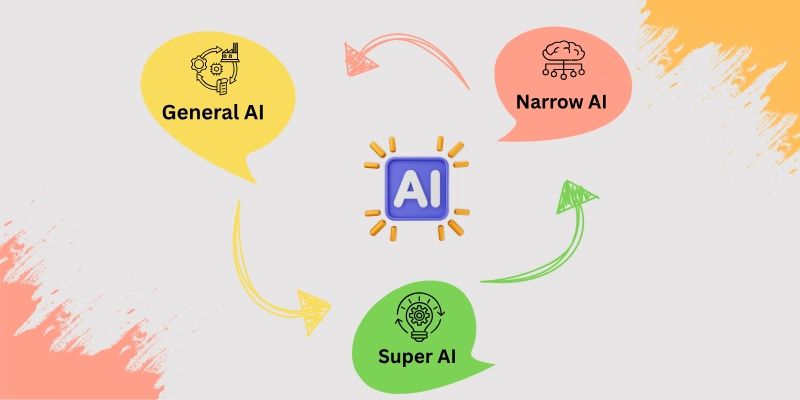
Here are some types of AI:
- Narrow AI
- General AI
- Super AI
Let’s look at them in detail.
Narrow AI
Narrow AI is the type of artificial intelligence that can do only one specific task. It follows set instructions and cannot think or learn beyond its job, even if it looks smart. This type of AI is commonly used in our daily lives, such as in voice assistants or map apps.
- Works in one area only.
- Cannot think like humans.
- Learn from data but only for its task.
- Used widely in daily life.
- Easy to control and manage.
Example: Google Maps is a Narrow AI. It helps you find the best route but cannot chat or answer general questions like a human.
General AI
General AI is the type of artificial intelligence that can think, learn, and solve problems like a human. It can understand different tasks, learn from experience, and make smart decisions across many areas.
- Can perform multiple tasks like a human.
- Learn from experience and improve over time.
- Can think, reason, and solve new problems.
- Not limited to one job or area.
- Still under development and not yet real.
Example: A robot teacher that can explain math, talk about science, understand your mood, and learn new things is an example of General AI, but only in theory for now.
Super AI
Super AI is a type of artificial intelligence that would be more intelligent than humans in every way. It could think, feel, learn, and make decisions better and faster than people. This type of AI would have its thoughts and ideas, making it completely independent from human control.
- Smarter than all human beings.
- Can think, plan, and solve big problems on its own.
- May have emotions, self-awareness, and independent thoughts.
- Still just an idea, not created yet.
- It could change the world completely if it becomes real.
Example: A future robot that can run a whole country, create its own ideas, and make better choices than any human. This is an example of Super AI in imagination.
AI based on functionalities
Based on functionalities, AI is divided into four main types. Each type shows how the AI system behaves, reacts, and makes decisions, starting from basic reactions to possibly becoming self-aware in the future.
- Reactive Machines
- Limited Memory
- Theory of Mind
- Self-Aware AI
Let’s look at them in detail.
Reactive Machines
Reactive Machines are the most basic type of artificial intelligence. They can only respond to the present situation and cannot remember past events or learn from experience.
- React only to current inputs.
- Do not store past data or memories.
- Cannot improve with experience.
- Follow fixed rules for specific tasks.
- Simple and limited in behavior.
Example: A chess-playing computer that looks at the current moves and chooses the best next move, without remembering past games. This is an example of a Reactive Machine.
Limited Memory
Limited Memory is a type of artificial intelligence that can use past data to make better decisions. It remembers small amounts of information for a short time and uses that to improve its performance.
- Can store and use past data for a short time.
- Learn from experience to make better choices.
- More advanced than reactive machines.
- Used in many modern AI systems.
- Still needs training and updates to work well.
Example: A self-driving car that remembers the speed of nearby vehicles, traffic lights, and road signs to drive safely. This is an example of Limited Memory AI.
Theory of Mind
Theory of Mind is a type of artificial intelligence that would be able to understand human emotions, thoughts, and intentions. This AI would recognize how people feel, what they believe, and why they act a certain way just like humans do when they talk to each other.
- Understands feelings, beliefs, and intentions.
- Can guess what others might think or do.
- Communicates in a more human-like way.
- Helps in social interactions and emotional tasks.
- Still being researched, not created yet.
Example: A robot assistant that can notice when you’re sad, understand your tone, and talk gently to comfort you. This is an example of Theory of Mind AI, still in development.
Self-Aware AI
Self-Aware AI is the most advanced type of artificial intelligence, which would be able to understand itself and be fully conscious. It would have its own thoughts, emotions, and a deep awareness of its existence, just like a human being.
- Fully aware of its own mind and body.
- Has emotions, desires, and self-control.
- Can make independent decisions.
- Acts and reacts like a real person.
- Still imaginary, not developed yet.
Example: A future robot that knows it is a robot, thinks about its future, and says things like “I feel nervous before a test”.This is an example of Self-Aware AI, only seen in science fiction for now.
Why It’s Important to Know AI Types
Understanding the types of AI helps us see how smart machines work and how they are changing the world around us. It also shows us the step-by-step journey from simple machines to powerful, human-like intelligence.
- Helps us learn what AI can and cannot do.
- Makes it easier to use AI safely and smartly.
- Shows how AI is improving with time.
- Prepares us for future changes in technology.
- Helps students and beginners understand AI clearly.
Conclusion
In this article, we’ve learned about Types of AI. Artificial Intelligence (AI) comes in different types, from simple task-based systems to advanced machines that can learn and think.
As AI grows, it continues to change how we work, live, and connect with technology. Understanding the types of AI helps us use it better and prepare for the future.
Now that you know the types of AI, stay curious and keep exploring how artificial intelligence is shaping our world. Red our next article on Future of AI.
I hope you found this article useful. Feel free to share your thoughts in the comment section below!
FAQs
Have more questions about AI? Check out the FAQs below for clear and simple answers!
It is important to know the types of AI so we can understand how smart machines work. This helps us use AI in the right way and stay safe with new technology. It also shows how AI is growing step by step, from simple tools to advanced systems.
Theory of Mind AI is a type of artificial intelligence that can understand human thoughts, feelings, and intentions. It knows that people have emotions and different ways of thinking. This type of AI is still being developed and does not exist yet.
The type of AI used in daily life today is called Narrow AI. It can do only one specific task, like giving directions or answering simple questions. Examples include voice assistants, chatbots, and Google Maps.
Most AI today cannot think like a human. It can follow rules and make simple decisions, but it doesn’t truly understand or feel. Only General AI, which is still being developed, is meant to think and learn like humans.
Yes, Chatgpt is an example of Narrow AI. It is designed to understand text and give helpful answers, but it cannot think or feel like a human. It works by using data to give smart replies based on your questions.
Limited Memory AI in cars helps them drive safely by remembering past information for a short time. It uses data like speed, traffic signs, and nearby cars to make better driving decisions.
No, AI cannot feel real emotions like humans. It can recognize emotions in voices or faces, but it does not truly understand or feel them. Some future types like Theory of Mind AI or Self-Aware AI may try to copy emotions, but they are not real.
No, AI cannot feel real emotions like humans. It can recognize emotions in voices or faces, but it does not truly understand or feel them. Some future types like Theory of Mind AI or Self-Aware AI may try to copy emotions, but they are not real.
AI can be helpful, but if not used carefully, it might be dangerous in the future. Very advanced AI could make big decisions on its own, which may not always be safe. That’s why it’s important to create rules and use AI responsibly.
The goal of Super AI is to be smarter than humans in every way. It would be able to think, feel, and make its own decisions better and faster than people. This type of AI could solve big problems, but it is still only an idea for the future.



- Be Respectful
- Stay Relevant
- Stay Positive
- True Feedback
- Encourage Discussion
- Avoid Spamming
- No Fake News
- Don't Copy-Paste
- No Personal Attacks
- Be Respectful
- Stay Relevant
- Stay Positive
- True Feedback
- Encourage Discussion
- Avoid Spamming
- No Fake News
- Don't Copy-Paste
- No Personal Attacks
