AI in Business – Explained in Simple Words
Published: 16 Aug 2025
Have you ever wondered how some companies know exactly what you want or reply to your questions within seconds? This is often the magic of AI, or artificial intelligence, which simply means that computers can think and learn like humans.
In today’s business world, AI is helping companies work faster, make smart decisions, and understand their customers better. From improving customer service to predicting future trends, AI is becoming a powerful tool for business success.
In this guide, we’ll learn about the Role of AI in business.
Business Before AI
Before AI, businesses worked in traditional ways. Most tasks were done manually by people. Employees spent a lot of time on routine work like data entry, customer support, and analyzing reports. This made work slower and sometimes caused mistakes.
Decision-making was also slower. Managers had to study reports, guess trends, and make plans without much help from technology. Marketing and customer services were less personalized because businesses could not easily understand what each customer wanted.
Companies also had limited tools to predict future trends or find new opportunities. Everything depended on human experience, which was useful but not always accurate.
AI in Business
AI is playing an important role in transforming businesses today. Its main purpose is to make work faster, smarter, and more efficient.
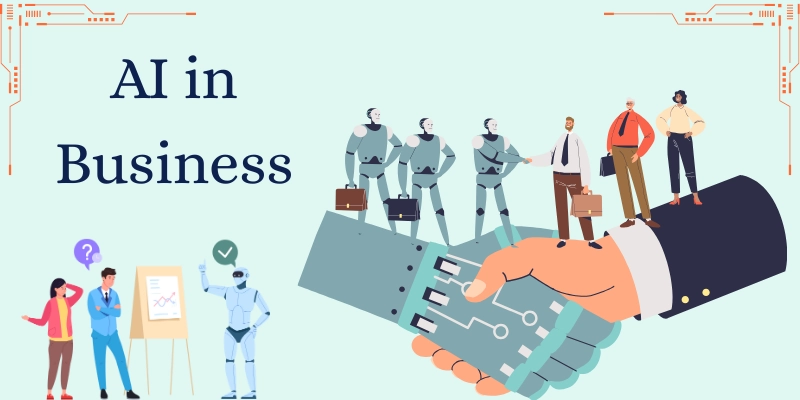
Here are some key points with examples:
- Business Tasks
AI can take care of small and repetitive jobs that humans usually spend a lot of time on.
Example: AI tools can handle data entry, send emails, schedule meetings, or manage inventory automatically.
This saves employees’ time so they can focus on more important work. AI also reduces human errors in routine tasks. Companies can run smoothly and faster because these tasks are done automatically. - Better Decisions
AI can quickly study large amounts of data and find useful patterns. This helps business owners and managers make smart decisions.
Example: AI can predict which products might sell more or warn about possible risks before they happen.
AI also helps in spotting new opportunities that humans might miss. Businesses can plan strategies more confidently with AI insights. - Customer Service
AI chatbots and virtual assistants can answer customer questions instantly, even at night or on weekends.
Example: If you visit an online store at night, an AI chatbot can instantly answer your questions, help you find products, or place an order, no waiting needed.
This makes customers happier because they get help anytime. Businesses can also handle more customer requests without hiring extra staff. - Operational Costs
When AI takes over routine tasks and improves efficiency, businesses spend less money on labor and mistakes.
Example: AI can optimize delivery routes to save fuel or manage resources to reduce waste.
AI also helps businesses use materials more efficiently and avoid unnecessary spending. Overall, companies can save money while working smarter. - Marketing and Sales
AI helps businesses reach the right customers at the right time.
Example: AI can suggest personalized offers, send emails to interested customers, or recommend products based on their past behavior.
This makes marketing more effective and increases sales. AI also studies customer feedback to improve products and services, helping businesses grow faster.
Why Does AI Matters in the Business World?
AI matters in the business world because it helps companies work faster, smarter, and more efficiently. It can handle repetitive tasks, analyze large amounts of data, and provide insights that humans might miss.
This allows business leaders to make better decisions and plan for the future. AI also improves customer service by giving instant support and personalized experiences. Additionally, it helps reduce costs, prevent errors, and optimize resources.
Popular Uses of AI in Different Business Areas
AI is used in many areas of business to make work easier and smarter.
- In marketing and advertising, AI helps create personalized ads, predict customer behavior, and suggest the best marketing strategies.
- In finance and banking, it detects fraud, manages risks, and automates transactions.
- In manufacturing and production, AI improves efficiency, monitors machines, and predicts maintenance needs.
- In retail and e-commerce, it recommends products, manages inventory, and improves customer experiences.
- In logistics and transport, AI optimizes delivery routes, tracks shipments, and reduces costs.
Advantages of Using AI in Business
- Faster Work: AI can complete repetitive tasks much faster than humans.
Example: it can process invoices, manage emails, or update records automatically. This saves employees’ time and lets them focus on important work. - Data Handling: AI can analyze large amounts of data without making mistakes. This helps businesses make better decisions and avoid costly errors.
Example: AI can track sales data or detect fraud accurately. - Customer Support: AI chatbots and virtual assistants can answer customer questions at any time of the day or night.
Example: If you ask a question on a bank’s website at midnight, an AI chatbot can instantly help you check your account or solve issues without waiting for a human agent. - Customer Experience: AI studies customer behavior and preferences to offer recommendations, discounts, or services tailored to each person.
Example: E-Commerce websites suggest products based on what you viewed or bought before.
Limitations of AI in Business
While AI offers many benefits, it also has some limitations.
- Setting up AI systems and training them can be expensive, which may not suit small businesses.
- AI also raises security and privacy concerns, as sensitive data can be at risk if not handled properly.
- AI lacks creativity and intuition, so it cannot replace human thinking in complex situations.
- Additionally, using AI may lead to a risk of job loss, as machines can take over tasks previously done by humans.
Examples of AI in Action
AI is used in many ways in businesses today.
- Chatbots on company websites answer customer questions instantly, even outside office hours.
- AI-driven ad targeting helps businesses show the right ads to the right people, increasing sales.
- In factories, predictive maintenance uses AI to monitor machines and prevent breakdowns before they happen.
- Voice assistants in customer support help customers get information or resolve issues quickly without waiting for a human agent.
Responsible Use of AI in Business
Using AI responsibly is very important for businesses. It helps protect customer trust, follow the law, and make fair decisions. Here are the main practices for responsible AI use:
- Laws and rules: Businesses should follow regulations related to AI and data usage to avoid legal issues.
- Data: Customer information must be protected from theft, leaks, or misuse.
- Unfair bias: AI systems should be designed to make fair decisions and not discriminate against anyone.
Funny Predictions
- AI Bosses: Soon, AI might become the “office boss” who never complains or takes a coffee break, but will probably send 500 emails a day!
- Robot Coworkers: Imagine AI coworkers reminding you to “stop slacking” or “take a break” in the middle of a Zoom call. No hiding now!
- Smart Coffee Machines: AI might suggest your coffee based on your mood or even tell you, “Skip sugar, you’ll crash in 2 hours!”
- Predicting Weird Trends: AI could predict that everyone suddenly wants avocado-flavored toothpaste or glow-in-the-dark socks… and businesses might actually sell them!
- Virtual Shopping Spree: AI might add things to your online cart before you even realize you want them: “You need 3 more rubber ducks, trust me!”
Conclusion
In this guide, we’ve learned about the Role of Artificial Intelligence in business. AI is playing a growing role in business by helping companies make smarter decisions, improve efficiency, and serve customers better.
It can analyze data quickly, automate tasks, and predict trends, giving businesses a big advantage. Companies should adapt to AI to stay competitive, save time, and grow faster. Using AI wisely helps businesses succeed in today’s fast-changing world.
I hope this article helped you understand AI in business. Share your thoughts in the comment section below!
FAQs
Have more questions about AI in business? Check out the FAQs below for quick answers!
AI in business is the use of artificial intelligence technology to help companies work smarter and faster. It can automate tasks, analyze data, improve decisions, and enhance customer experiences.
AI helps businesses by automating tasks, analyzing data for better decisions, improving customer service, and reducing costs, making operations faster and more efficient.
AI can handle many repetitive or routine tasks, but it cannot fully replace human employees because it lacks creativity, intuition, and emotional understanding.
Examples of AI in business include chatbots on websites, AI-driven ad targeting, predictive maintenance in factories, and voice assistants in customer support.
AI helps in marketing by analyzing customer behavior, creating personalized ads, predicting trends, and recommending the right products to the right people, making campaigns more effective.
Yes, AI can improve customer service by providing 24/7 support through chatbots and virtual assistants, answering questions instantly, resolving issues faster, and offering personalized assistance.
Yes, AI reduces business costs by automating routine tasks, minimizing errors, optimizing resources, and improving efficiency, which saves time and money for companies.
Yes, AI is useful for small businesses because it can automate tasks, analyze data, improve customer service, and optimize operations, helping them compete with larger companies without needing a big team.
Yes, AI can analyze business data by quickly studying large amounts of information, identifying patterns, predicting trends, and helping businesses make smarter decisions.
Yes, AI will change the future of business by making operations faster, smarter, and more efficient, improving decision-making, enhancing customer experiences, and creating new opportunities for growth.





- Be Respectful
- Stay Relevant
- Stay Positive
- True Feedback
- Encourage Discussion
- Avoid Spamming
- No Fake News
- Don't Copy-Paste
- No Personal Attacks
- Be Respectful
- Stay Relevant
- Stay Positive
- True Feedback
- Encourage Discussion
- Avoid Spamming
- No Fake News
- Don't Copy-Paste
- No Personal Attacks
