History of AI – From Ancient Dreams to Modern Reality
Published: 16 Aug 2025
How did we get from a world with no computers to one where machines can talk, draw, and solve problems on their own? The answer lies in the History of AI.
This history starts in the mid-20th century, when scientists first tried to teach computers how to “think.” In the early days, AI could only do basic tasks, but over time, it learned to play games, understand speech, and even create art.
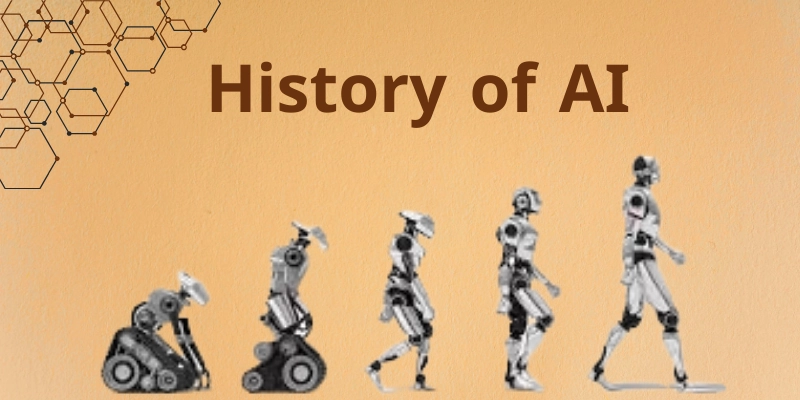
The history of AI is filled with surprising turns, challenges, and breakthroughs. By following this story, you can see how ideas once thought impossible became part of everyday life.
History of AI
People have been thinking about artificial intelligence for a very long time. Even before computers existed, humans imagined machines that could act like people. Here’s how the idea started and slowly developed over time:
- The idea of artificial intelligence is very old.
- People have imagined smart machines for thousands of years.
- Ancient philosophers wondered if non-living things could think or act like humans.
- Long ago, inventors made machines called automatons.
- Automatons were mechanical devices that could move on their own without human help.
- The word automaton comes from ancient Greek and means “acting of one’s own will.”
- Around 400 BCE, a friend of the philosopher Plato made a mechanical pigeon.
- In 1495, Leonardo da Vinci designed a famous automaton that looked like a knight and could move its arms and head.
- These early machines were interesting but were not true AI.
- They could not think, learn, or make decisions.
- Modern AI began to develop in the 20th century, when scientists created machines that could process information and make choices.
Groundwork for AI (1900–1950)
In the early 1900s, books and plays often talked about artificial humans. This inspired scientists to ask a big question: Can we build an artificial brain?
Some inventors made simple robots powered by steam. These robots could move, make faces, and even walk. The word “robot” was first used in 1921 in a Czech play called Rossum’s Universal Robots.
Important events:
- 1921: Playwright Karel Čapek introduced the word “robot.”
- 1929: Japanese professor Makoto Nishimura built Japan’s first robot, Gakutensoku.
- 1949: Computer scientist Edmund Callis Berkley published Giant Brains, or Machines that Think, comparing new computers to human brains.
Birth of AI (1950–1956)
The early 1950s marked the beginning of modern AI. British scientist Alan Turing wrote a paper called Computing Machinery and Intelligence in 1950. He suggested a way to test if a computer could “think”; this became known as the Turing Test.
AI became a real field of study in 1955 when scientist John McCarthy held a workshop at Dartmouth College. He used the term artificial intelligence, and the name stuck.
Important events:
- 1950: Alan Turing proposed the Turing Test.
- 1952: Arthur Samuel made a program that could teach itself to play checkers.
- 1955: John McCarthy introduced the term “artificial intelligence.”
AI Growth and Challenges (1957–1979)
After the term “AI” was created, researchers made quick progress. They built new programming languages, such as LISP, which is still used today for AI work. Robots began to appear in factories, and early chatbots were created.
However, not everything went smoothly. In the 1970s, some governments cut funding for AI because they felt progress was slower than promised.
Important events:
- 1958: John McCarthy created LISP.
- 1959: Arthur Samuel used the term machine learning for the first time.
- 1961: The first industrial robot, Unimate, worked on a car assembly line.
- 1965: The first expert system was created to copy human decision-making.
- 1966: Joseph Weizenbaum made ELIZA, an early chatbot.
- 1973: The UK cut AI funding after a critical government report.
- 1979: The Stanford Cart became one of the first driverless vehicles.
AI Boom (1980–1987)
The 1980s brought a wave of excitement. Governments funded AI research again. Expert systems became popular. These were programs that made decisions like human specialists.
Important events:
- 1980: The first commercial expert system, XCON, was released.
- 1981: Japan invested $850 million in the Fifth Generation Computer Project.
- 1985: AARON, an autonomous art program, was shown publicly.
- 1986: The first driverless car was tested in Germany.
AI Winter (1987–1993)
By the late 1980s, excitement faded. AI was expensive and often failed to meet expectations. Funding dropped, and progress slowed. This period is known as the AI Winter.
Important events:
- 1987: The market for specialised AI hardware collapsed.
- 1988: Programmer Rollo Carpenter created the chatbot Jabberwacky.
Rise of AI Agents (1993–2011)
In the 1990s and 2000s, AI made a comeback. Computers became faster and cheaper. AI started to appear in everyday products.
Important events:
- 1997: IBM’s Deep Blue beat world chess champion Garry Kasparov.
- 2000: Cynthia Breazeal made Kismet, a robot that showed emotions.
- 2002: The first Roomba robot vacuum was sold.
- 2003: NASA’s Mars rovers navigated without human help.
- 2011: IBM’s Watson won the game show Jeopardy!
- 2011: Apple released Siri, a virtual assistant.
Modern AI (2012–Present)
Recent years have seen big advances thanks to deep learning and big data. AI can now recognise faces, understand speech, and create images.
Important events:
- 2012: Google’s neural network learned to recognise cats without labels.
- 2016: Sophia, the robot, was created with human-like looks and emotions.
- 2017: Facebook AI chatbots developed their own language.
- 2020: OpenAI introduced GPT-3, a powerful language model.
- 2021: OpenAI created DALL·E, which generates images from text.
The Future of AI
No one can predict the future with certainty. But experts expect AI to become even more common in daily life. Businesses may use it more, robots may work alongside humans, and self-driving cars could become normal.
AI will create new opportunities but also bring challenges, like job changes and ethical questions. The story of AI is still being written, and we are living in one of its most exciting chapters.
Conclusion
So guys, it’s time to wrap up. In this article, we’ve covered the History of Artificial Intelligence in detail. We’ve seen how ideas from thousands of years ago have shaped the powerful technology we use today.
In my view, knowing this history gives you a deeper appreciation for AI and its potential. I suggest you explore AI tools and see how they can help in your work or studies. Now it’s your turn.
What do you think the next chapter of AI history will look like? Share your thoughts in the comments.
FAQs
Here are some frequently asked questions related to the history of AI:
The history of AI is the story of how people created machines that can think and act like humans. It started with old ideas about smart machines and grew into today’s advanced technology.
John McCarthy is called the father of AI. He was a computer scientist who first used the term “artificial intelligence” in 1956.
AI started as a real science in the 1950s. Before that, people only imagined it in stories and mechanical inventions.
The earliest AI programs could solve math problems, play games like chess, and understand simple language. They were made in the 1950s and 1960s.
The oldest idea of AI comes from ancient times, when philosophers and inventors imagined machines that could move and act like humans.
AI has grown from simple machines to smart systems that can learn, see, talk, and make decisions. It’s now used in phones, cars, and even medicine.
Knowing the history of AI helps us understand how it works today and where it might go in the future. It also shows how human creativity drives technology.
AI winters are times when people lose interest in AI because progress has been slow. Funding and research also dropped during these periods.
AI became popular again when computers became faster, data became easier to collect, and new algorithms made AI more powerful.
Based on its history, AI will likely keep growing, becoming even more helpful in daily life, science, and business. But it will also need careful rules to use it safely.





- Be Respectful
- Stay Relevant
- Stay Positive
- True Feedback
- Encourage Discussion
- Avoid Spamming
- No Fake News
- Don't Copy-Paste
- No Personal Attacks
- Be Respectful
- Stay Relevant
- Stay Positive
- True Feedback
- Encourage Discussion
- Avoid Spamming
- No Fake News
- Don't Copy-Paste
- No Personal Attacks
