How to Learn AI – Step-by-Step for Beginners
Published: 14 Aug 2025
Artificial Intelligence, or AI, is the science of making computers and machines act like humans. AI can learn, think, and make decisions. You see AI every day, in voice assistants like Siri, in chatbots, in YouTube recommendations, and even in self-driving cars.
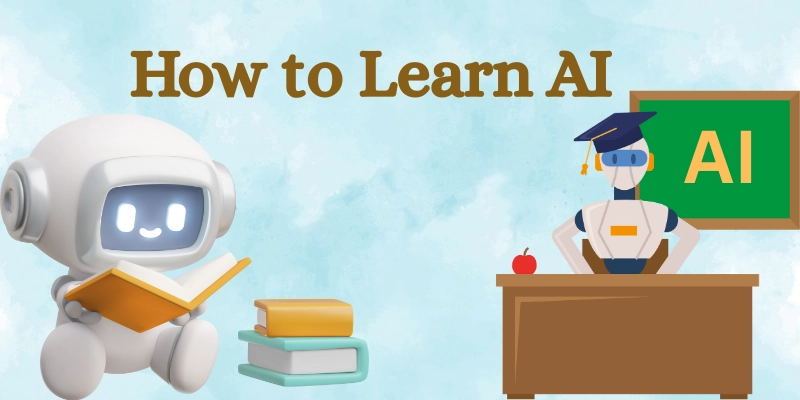
Learning AI can seem scary at first, but you don’t need to be a genius to start. You just need a plan, patience, and practice. In this guide, we’ll walk through four simple steps to start your AI learning journey.
Learn AI
Learning AI can feel overwhelming at first, but breaking it into clear steps makes it easier. With the right plan, you can build your skills step-by-step and gain confidence as you go.
Here are four simple steps you can follow to start learning AI:
Create a Learning Plan
Before you start learning, make a simple plan. This plan will help you stay on track and avoid feeling lost.
Here’s what to think about:
- Your current knowledge – Are you a complete beginner? Do you already know basic math, statistics, or coding?
- Your goal – Do you want a new career in AI or just add AI skills to your current job?
- Your time – Can you study full-time, or will you learn in your free time?
- Your budget – Can you pay for a boot camp or course, or do you want to use free YouTube and online resources?
- Your learning style – Do you prefer self-study, online courses, or going to a university?
Tip: Write down your answers. This will help you pick the right learning path.
Master the Basics Before AI
AI is built on a few core skills. If you understand these, learning AI will be much easier.
1. Basic Statistics
Statistics help AI understand and work with data. Learn:
- Percentages
- Averages
- Probability
- Patterns in data
Example: Statistics help AI guess which product you might buy next based on your past shopping.
2. Basic Math
AI uses math to make decisions. Start with:
- Algebra (working with formulas)
- Probability (predicting chances)
- Simple calculus and linear algebra (only for advanced AI work later)
3. Curiosity and Problem-Solving
AI changes fast. You must love learning new things and finding creative solutions.
Start Learning AI Skills
Once you have the basics, you can start learning the main skills for AI.
1. Programming
Learn to code. Python is the most popular for AI because it’s easy and has many AI tools. R, Java, and C++ are also used.
2. Data Structures
These are ways to store and organise data. Examples are:
- Lists
- Arrays
- Trees
Why is it important? AI needs to handle huge amounts of data in an organized way.
3. Data Science
Data science is about finding useful patterns in data. AI uses this to make better decisions.
4. Machine Learning
This is when a computer learns from examples. For example, you can show an AI 1,000 cat photos, and it learns to spot cats in new pictures.
5. Deep Learning
This is advanced machine learning. It uses “neural networks” that act like the human brain. Deep learning powers self-driving cars, face recognition, and language translation.
Get Familiar with AI Tools
AI experts use special tools and libraries to work faster. Some popular ones for Python are:
- NumPy – works with numbers
- Pandas – handles data tables
- Scikit-learn – machine learning
- TensorFlow & PyTorch – deep learning
- Matplotlib & Seaborn – data charts and graphs
How Long Does It Take to Learn AI?
The time it takes to learn artificial intelligence is different for everyone. It depends on a few main things:
Before we look at the details, remember that your starting point plays a big role in how fast you learn. Some people can pick things up in months, while others may need more time.
- What you already know: If you already understand basic math and statistics, you can start learning AI skills and tools right away.
- Your career goal: If you want a job in AI, you will need deeper knowledge than someone who only wants to use AI in a smaller part of their work.
- Your background: If you are new to technology, it may take longer to learn. If you already work in tech and understand the basic terms, you will learn faster.
How to Make a Learning Plan
If you are learning AI on your own, you need a plan. A learning plan will help you stay focused and spend your time wisely.
Before jumping into the steps, think about how much time you can give each week. Consistent small efforts work better than random long study days.
Below is an example of a 9-month AI learning plan. Your own plan can be shorter or longer, depending on your goals.
Months 1–3: Learn the Basics
These first three months will set your foundation. The goal here is to understand the core skills you will need later.
- Math and statistics: Start with the basics of algebra, calculus, probability, and statistics. These skills will help you understand how AI works.
- Programming: Learn a programming language like Python or R. These are the most common in AI. Also, learn how to use libraries and packages.
- Data structures: Understand how to store, organise, and use data. Learn how to clean and prepare data for AI projects.
Months 4–6: Learn AI Core Skills
Now that you know the basics, it’s time to explore the main areas of AI. This is where you start connecting concepts to real AI work.
- Data science: Study how data is collected, processed, and analysed. Learn how AI can help find patterns in data.
- Machine learning: Learn different types of machine learning, such as supervised, unsupervised, and reinforcement learning.
- Deep learning: Learn about neural networks and how deep learning models work.
Months 7–9: Build AI Projects and Specialise
In this stage, you’ll apply your skills to projects and choose the AI path that excites you most.
- AI tools: Start using AI libraries in Python, such as TensorFlow, PyTorch, or Scikit-learn. Also, try tools like ChatGPT.
- Specialisation: Pick an area of AI to focus on, such as natural language processing, computer vision, or AI for business.
- Career growth: If you want an AI job, start applying now. Also read AI blogs, watch tutorials, and listen to podcasts to keep learning.
Conclusion
So guys, it’s time to wrap up. In this article, we’ve covered how to learn Artificial Intelligence in detail. From building a strong foundation in math and programming to exploring AI tools and projects, the journey can be both exciting and rewarding.
My personal advice is to start small, stay consistent, and keep experimenting with real-life projects. This is the fastest way to grow your skills. Now, take the first step today and begin your AI learning journey with confidence.
FAQs
Here are frequently asked questions related to how to learn AI:
Learning AI can take anywhere from a few months to several years, depending on your background and goals. If you study full-time with some prior knowledge, you may grasp the basics in 6–9 months. For deeper expertise, expect a longer journey.
Yes, basic coding knowledge is very important for AI. Python is the most popular language for AI because it’s simple and has many useful libraries. You don’t need to be an expert, but you should be comfortable writing and understanding code.
You can, but having a basic understanding of math will make it easier. AI uses concepts from algebra, calculus, and statistics. You can learn these step-by-step alongside your AI studies.
Python is the best choice for beginners because it’s simple and widely used in AI. R and Java are also used, but Python has the largest community and most learning resources. Start with Python, then explore others if needed.
You’ll need skills in math, programming, data analysis, and problem-solving. Knowledge of machine learning and AI tools is also important. Over time, you can specialise in areas like computer vision or natural language processing.
Yes! Many free resources are available, including online courses, YouTube tutorials, and open-source books. Starting with free material can help you decide if AI is right for you before investing in paid programs.
AI is the overall concept of making machines think and act like humans. Machine learning is a part of AI that focuses on teaching computers to learn from data. In simple terms, ML is one way to achieve AI.
Start by working on small projects, like predicting house prices or recognizing images. Use platforms like Kaggle for datasets and competitions. Practicing regularly is the best way to build confidence.
A degree helps, but it’s not always required. Many AI jobs focus more on skills and project experience than formal education. Building a strong portfolio can open doors even without a degree.
Explore different fields like robotics, computer vision, and natural language processing. See which one excites you the most. Once you find your interest, focus on that area to build deep expertise.





- Be Respectful
- Stay Relevant
- Stay Positive
- True Feedback
- Encourage Discussion
- Avoid Spamming
- No Fake News
- Don't Copy-Paste
- No Personal Attacks
- Be Respectful
- Stay Relevant
- Stay Positive
- True Feedback
- Encourage Discussion
- Avoid Spamming
- No Fake News
- Don't Copy-Paste
- No Personal Attacks
