How Often Is AI Wrong? What You Should Know About Errors
Published: 10 Dec 2025
Artificial intelligence is everywhere now. People use it for writing, research, coding, business planning, and even for answering questions in daily life. With this much use, it’s natural to ask: How often is AI wrong?
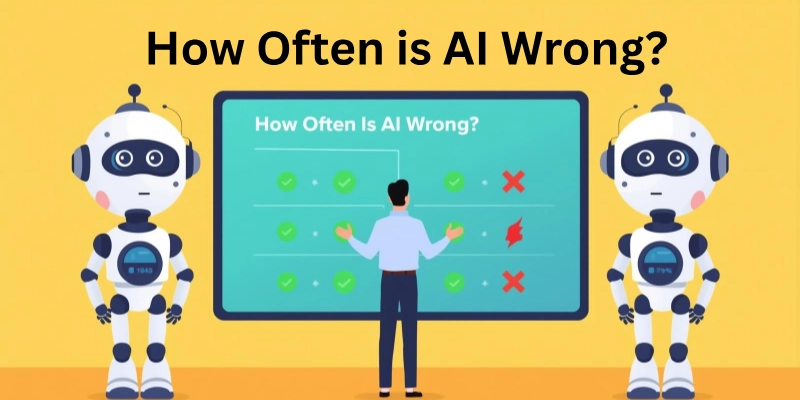
The answer isn’t simple. AI can be very accurate in some situations and surprisingly unreliable in others. At times, it produces helpful insights. Other times, it gives wrong answers that sound completely confident. Many people have already complained about Google AI being wrong, search assistants misunderstanding queries, or tools like ChatGPT giving a wrong answer during a simple task.
This article breaks down how often AI is incorrect in real-world use, why mistakes happen, where AI goes wrong most often, and how you can use these tools safely.
Reality Check – Can We Measure Exactly How Often AI Is Incorrect?
There is no universal error rate for all Artificial Intelligence systems. Different tools behave differently, and even the same model may perform well in one area and poorly in another.
Studies from 2024 and 2025 show that:
- Some high-level models produce less than 1% hallucinations in controlled tests.
- Others show 20% to 30% error rates in open-ended tasks.
- When summarizing scientific papers, accuracy can drop sharply, and AI wrong answers become more common.
- In news summarization tests, more than half of generated summaries contained major errors.
This wide gap shows how unpredictable AI can be. People ask, “Is AI ever wrong?” or “Is AI always correct?” The honest answer is that AI can be correct or completely off-track depending on what you ask and how you use it.
When tasks get complex, there’s a higher chance of AI making mistakes. That’s why you often see discussions about AI going wrong in research, journalism, or business decision-making.
Updated Real-World Data: Where AI Gets It Right and Where It Fails
To understand how often AI is correct or incorrect, let’s look at some real situations.
1. News Summaries and Fact-Based Questions
AI tools are often unreliable with fast-changing information like news. A 2025 review showed that over 50% of news summaries had wrong or misleading points. This includes wrong dates, missing context, and even fabricated details.
People also see Google AI giving wrong answers directly in search. Over the past year, multiple reports highlighted cases where AI search results misquoted facts or misinterpreted current events.
When it comes to daily queries, AI for answering questions can be helpful, but it does not always verify its own output. This makes it easy for misinformation to slip in.
2. Academic and Scientific Content
Summaries of research papers remain one of the weakest areas for AI. A large 2025 study found that up to 73% of AI-generated scientific summaries contained errors, missing details, or oversimplified explanations.
So when people ask “Why is AI so inaccurate?” or “How often is AI correct?” they are usually referring to problems that show up in academic, scientific, or expert-level topics.
3. Everyday Use: Writing, Chatting, Brainstorming
In daily tasks, the error rate is lower. AI can help with drafts, ideas, and explanations. But even here, it sometimes produces outdated facts or confidently wrong claims. Many users have experienced a ChatGPT wrong answer when asking something detailed or niche.
In user surveys, around 15% of AI output contained fabricated details, and nearly 25% was irrelevant or off-topic.
Why Does AI Make Mistakes?
AI mistakes don’t happen randomly. There are specific reasons behind them.
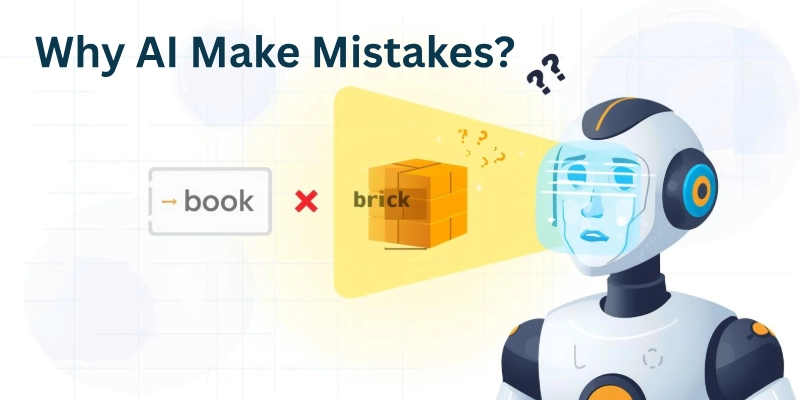
1. Weak or Incomplete Training Data
AI is trained on huge datasets gathered from the internet. That data can be outdated or inaccurate, which leads directly to AI being wrong about facts, science, historical details, or new technologies.
2. AI Doesn’t Truly Understand Meaning
AI predicts patterns. It doesn’t understand the world the way humans do. Because of this, AI making mistakes is common when a question needs deep reasoning.
This is also why AI sometimes:
- Gives logical-looking answers that are actually wrong
- Invents facts
- Cites non-existent references
- Mixes unrelated information
3. Lack of Real-Time Verification
Unlike search engines, many AI models don’t check live sources. So AI giving wrong answers becomes common when the question requires updated data or recent events.
4. Context and Prompt Confusion
If your prompt is unclear, too short, or too broad, AI can be wrong because it fills the gaps with assumptions.
How Bad Are AI Mistakes? (From Small Errors to Serious Failures)
AI errors fall into different levels.
1. Small Errors
These include spelling mistakes, dates that are slightly off, or minor details that don’t affect the full meaning.
2. Misleading Errors
Here, AI is technically wrong but sounds confident. Many examples of AI being wrong fall under this category. This includes mixing facts, misrepresenting quotes, or giving false context.
A user might think the answer is true because the writing style seems polished.
3. Serious, High-Risk Mistakes
When it comes to legal, medical, scientific, or financial content, mistakes carry real risks.
Examples include:
- Inventing medical advice
- Giving fake laws
- Misquoting scientific findings
- Suggesting dangerous actions
This is where users need to be extra cautious.
Where AI Goes Wrong Most Frequently
Research from 2024–2025 shows consistent patterns in tasks where AI going wrong is most likely:
- Summarizing research papers
- Giving factual answers without sources
- Explaining legal or medical information
- Translating complex technical content
- Interpreting news articles
- Generating citations
- Answering niche questions
This is why many users ask, “Why is AI wrong so often?” The reason is that these tasks require precision that AI writing models still lack.
When You Can Trust AI and When You Shouldn’t
AI is good when:
- You need drafts
- You want creative ideas
- You want help rewriting or improving text
- Accuracy isn’t critically important
Be careful when:
- You need facts
- Decisions involve money or health
- You’re working on academic or scientific writing
- You’re checking laws, rules, or research findings
AI is a strong assistant, but it should not be the final authority.
What Developers Are Doing to Reduce AI Mistakes
AI companies know the issue and are working on improvements:
- Better training data
- Fact-checking layers
- Uncertainty indicators
- Human oversight systems
- Retrieval-based answers
- Updated benchmarking
These changes help, but they don’t eliminate errors fully. For now, humans still need to verify important information.
Conclusion
So, guys in this article we have discussed how often is Artificial Intelligence wrong? There’s no single number, but real-world results show it can be anywhere from under 1% in easy tasks to over 50% in complex ones.AI is helpful, fast, and powerful. But it is not perfect, and can AI be wrong? Yes very often, depending on the situation.
Treat AI output like a draft. Use it for ideas, summaries, and writing help, but double-check anything important. The smarter you use AI, the fewer problems you’ll face.
FAQs: How often is AI Incorrect
If you still have questions about how often AI makes mistakes or why tools like Google AI or ChatGPT give wrong answers, these FAQs will help clear things up.
Yes, AI can be wrong when it misunderstands the prompt or predicts something based on incomplete patterns. It doesn’t truly “know” things; it only guesses from data. That is why can AI be wrong is a common concern for users.
Google’s AI tools are improving, but they still make mistakes when the data is unclear or the topic is too new. Error rates vary depending on the task. This is why people sometimes search how often is google AI wrong to understand its reliability.
You can ask as many questions as you want, but each session has limits based on your plan. The quality of answers may change with complex or lengthy queries. This is why users sometimes wonder how many questions can you ask chatgpt in one go.
AI makes mistakes when the training data has gaps or biases. It also struggles with context, sarcasm and real-world judgment. These issues explain why people often ask why does AI make mistakes in the first place.
The frequency depends on the task, like translation, writing or math. Simple tasks are usually more accurate than open-ended questions. Because of this, many users check how often doesAI make mistakes before trusting the output.
AI can be wrong often when it tries to predict answers instead of pulling exact facts. It sometimes fills in gaps with guesses. This leads people to wonder why is AI wrong so often across different platforms.
Some users get frustrated when search responses or summaries include errors. Others feel the results don’t match their expectations. That’s why you sometimes see terms like i hate google AI in discussions online.




- Be Respectful
- Stay Relevant
- Stay Positive
- True Feedback
- Encourage Discussion
- Avoid Spamming
- No Fake News
- Don't Copy-Paste
- No Personal Attacks
- Be Respectful
- Stay Relevant
- Stay Positive
- True Feedback
- Encourage Discussion
- Avoid Spamming
- No Fake News
- Don't Copy-Paste
- No Personal Attacks
