Where AI Is Used – Top Applications of Artificial Intelligence
Published: 22 Aug 2025
Artificial Intelligence (AI) is no longer a futuristic dream, it’s already here, transforming our daily lives and industries worldwide. From unlocking your phone with face recognition to shopping recommendations on Amazon, AI is silently working in the background.
But the question is, where is AI used the most today? In this article, we’ll explore real-world applications of AI across industries and daily life.
Where AI Is Used Today- An Overview
AI is present almost everywhere around us. It powers smartphones, drives business growth, manages traffic, and even helps in hospitals. The biggest advantage is its ability to process massive data quickly and provide smart solutions.
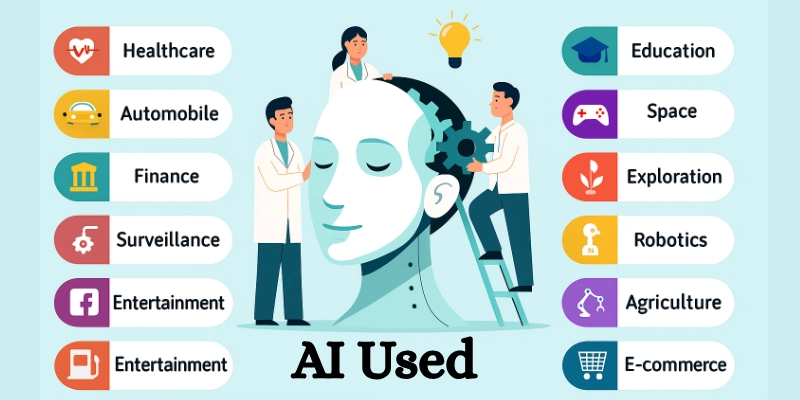
Some common uses include:
- Virtual assistants like Siri, Alexa, and Google Assistant.
- Recommendation systems on Netflix, YouTube, and Spotify.
- Fraud detection in banking apps.
- Face recognition for security.
- Chatbots in customer service.
AI in Business & Marketing
AI in Business & Marketing is transforming how companies connect with their customers and make decisions.
- Customer Insights: AI studies purchase behavior to predict what people want. This helps businesses design better products and services.
- Personalization: Online stores like Amazon use AI to recommend tailored products. It increases customer satisfaction and boosts sales.
- Chatbots & Support: AI chatbots provide 24/7 customer support. They solve simple queries instantly and reduce workload for humans.
- Fraud Detection: Banks use AI to identify suspicious activity. This protects customers from fraud and builds trust.
- Market Prediction: AI analyzes market data to predict trends. Businesses use these insights to stay ahead of competitors.
AI in Healthcare
AI in Healthcare is one of the most impactful applications, improving diagnosis, treatment, and patient care.
- Disease Detection: AI detects diseases like cancer and Alzheimer’s at early stages. Early detection can save countless lives.
- Medical Imaging: AI scans X-rays and MRIs with high accuracy. This reduces the chances of human error in reports.
- Drug Discovery: AI speeds up the discovery of new medicines. This allows treatments to reach patients faster.
- Virtual Health Assistants: AI-powered assistants remind patients about medicines and appointments. They also answer common health questions.
- Surgical Robots: Advanced AI robots assist doctors during surgeries. They make procedures safer and more precise.
AI in Education
AI in Education is reshaping how teachers teach and students learn worldwide.
- Personalized Learning: AI platforms adapt lessons based on a student’s pace. This makes learning easier and more effective.
- Tutoring Apps: Tools like Khanmigo use AI to provide personal tutoring. Students can get instant help at any time.
- Grading & Planning: AI automates exam grading and curriculum planning. This saves teachers valuable time.
- Smart Classrooms: AI systems track student engagement. Teachers get insights into who needs extra support.
- Language Learning: AI-powered apps like Duolingo improve pronunciation and grammar. This makes learning new languages fun.
AI in Transportation
AI in Transportation makes travel safer, faster, and more efficient.
- Self-Driving Cars: Companies like Tesla use AI to drive cars autonomously. These cars learn from data to improve road safety.
- Traffic Management: AI predicts traffic patterns in cities. This helps reduce congestion and travel time.
- Predictive Maintenance: AI checks vehicles for potential issues. Preventive action saves money and prevents accidents.
- Public Transport Optimization: AI designs bus and train schedules. This ensures smoother and more reliable services.
- Logistics & Delivery: AI powers route optimization in courier services. Companies like DHL and Amazon deliver faster using AI.
AI in Finance
AI in Finance is transforming banking, investments, and fraud prevention.
- Risk Management: AI predicts risks in loans and investments. This allows banks to make smarter financial decisions.
- Fraud Detection: AI instantly detects unusual activity in accounts. Customers are protected from scams and identity theft.
- Trading Bots: AI trading systems buy and sell stocks in seconds. They make financial markets more efficient.
- Customer Support: AI chatbots answer common banking queries. Customers get quick support without waiting.
- Credit Scoring: AI checks financial history more accurately than traditional methods. This helps people get fairer loan approvals.
AI in Entertainment & Media
AI in Entertainment & Media is making movies, music, and games more personalized.
- Recommendations: Netflix, YouTube, and Spotify suggest content using AI. Viewers enjoy a customized experience.
- Content Creation: AI tools generate art, scripts, and even songs. Creators use these tools to save time.
- Gaming: AI powers smarter opponents in video games. Players get more challenging and exciting experiences.
- Movie Production: AI analyzes audience preferences. Filmmakers use this data to create movies people love.
- Fake Detection: AI detects fake news and misinformation. This keeps media platforms more reliable.
AI in Smart Homes & Daily Life
AI in Smart Homes & Daily Life makes everyday living smarter and more convenient.
- Smart Assistants: Alexa, Siri, and Google Assistant perform tasks on voice command. They save time and make life easier.
- Smart Appliances: AI fridges suggest recipes based on available items. Washing machines optimize wash cycles to save energy.
- Home Security: AI-powered cameras detect unusual activity. They alert owners instantly to keep homes safe.
- Energy Saving: AI adjusts lighting and heating automatically. This reduces bills and helps the environment.
- Health Tracking: Smartwatches use AI to monitor heart rate and sleep. Users get useful insights about their health.
Future Outlook – Where AI Is Heading Next
The Future of AI promises even bigger changes across industries.
- Agriculture: AI monitors crop health and soil conditions. Farmers can increase productivity with fewer resources.
- Law & Legal Services: AI scans contracts and legal documents quickly. This saves time for lawyers and clients.
- Government & Policy: AI helps leaders analyze data for better decisions. Policies become more effective and people-focused.
- Climate Change Solutions: AI predicts weather and climate risks. This helps in disaster management and sustainability efforts.
- Robotics Expansion: AI robots will play a bigger role in industries. From warehouses to hospitals, their role will keep growing.
👉 To explore more, check our detailed guide on the Future of AI.
Conclusion
So, where is Artificial Intelligence used? The simple answer is almost everywhere from hospitals and schools to businesses, finance, entertainment, and even our homes. AI is not just shaping industries, it’s improving our daily lives in countless ways. As technology grows, we’ll see AI entering even more fields like agriculture, law, and government services. The future belongs to those who learn, adapt, and use AI wisely.
As AI keeps growing, its role in making life smarter, safer, and faster will only increase.
🤔 Frequently Asked Questions
Here are some common questions and answers about where AI is used in real life.
It depends on the purpose. For natural conversations, ChatGPT works well, while for image recognition, tools like Google Vision are better. The “best AI” is the one that solves your specific needs effectively.
AI is used in healthcare, finance, education, marketing, transportation, and cybersecurity. It also powers daily apps like assistants and streaming services. Its applications are growing every year.
AI is present in devices, apps, and systems around us. From hospitals and banks to social media and shopping sites, it powers many everyday services. Even when you search on Google, AI is working in the background.
AI detects threats, monitors unusual activity, and prevents cyberattacks in real time. Security systems use AI to analyze huge amounts of data quickly. This makes online safety stronger and faster than manual methods.
Currently, AI is most widely used in business and marketing. Companies rely on AI to understand customers, predict trends, and boost sales. Healthcare and finance are also top sectors for AI usage.
AI is used today in healthcare, transport, education, and entertainment. Apps, websites, and devices we use daily all run on AI. Its role is becoming bigger in both personal and professional life.
AI in healthcare helps doctors diagnose faster and more accurately. It is used in scanning, treatment planning, and virtual patient support. This improves care and saves time for both patients and doctors.





- Be Respectful
- Stay Relevant
- Stay Positive
- True Feedback
- Encourage Discussion
- Avoid Spamming
- No Fake News
- Don't Copy-Paste
- No Personal Attacks
- Be Respectful
- Stay Relevant
- Stay Positive
- True Feedback
- Encourage Discussion
- Avoid Spamming
- No Fake News
- Don't Copy-Paste
- No Personal Attacks
