Role of AI in Healthcare – Transforming the Future of Medicine
Published: 22 Aug 2025
Artificial Intelligence (AI) is changing the way we live, work, and even stay healthy. Among all industries, healthcare is one of the biggest beneficiaries of AI. From spotting diseases earlier to recommending better treatments, AI is helping doctors, hospitals, and patients in powerful ways.
So, what exactly is the role of AI in healthcare? Let’s break it down in simple words with clear examples.
Healthcare Before AI
Before AI entered healthcare, most processes were manual and time-consuming. Doctors had limited tools, and patients often faced delays in diagnosis and treatment. Let’s see what healthcare looked like before AI:
- Slow Diagnosis: Medical tests took a long time to process.
- Paper Records: Hospitals managed bulky files instead of digital systems.
- Limited Access: Many rural areas lacked expert doctors.
- Long Drug Discovery Process: Developing new medicines took years.
- High Costs: Treatments were expensive due to inefficiency.
In short, healthcare before AI was effective but far less efficient, leaving room for errors, delays, and higher costs.
AI in Healthcare
AI in healthcare means using smart computer systems to perform tasks that normally need human intelligence. These systems learn from medical data, recognize patterns, and assist in making decisions.
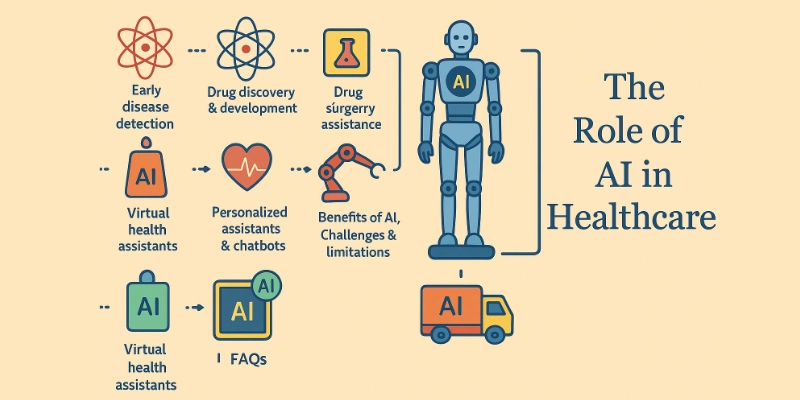
For example:
- Machine Learning (ML): Helps analyze medical records.
- Natural Language Processing (NLP): Reads and understands medical reports.
- Robotics: Assists in surgeries and patient care.
Healthcare systems face many challenges like rising costs, misdiagnosis, and lack of medical staff. This is where AI steps in to make things faster, accurate, and cost-effective.
Key Roles of AI in Healthcare
Here are some key roles of AI in Healthcare with examples:
1. Early Disease Detection & Diagnosis
AI tools can analyze X-rays, MRIs, and lab tests better and faster than humans. For instance, AI systems detect early signs of cancer or heart disease, giving doctors a head start in treatment.
👉 Example: Google’s AI model can spot breast cancer in scans with higher accuracy than human radiologists.
2. Drug Discovery & Development
Developing new medicines usually takes years. AI speeds up the process by predicting how different chemicals will react, reducing both time and cost.
👉 Example: During COVID-19, AI helped researchers test drug combinations faster than traditional methods.
3. Personalized Medicine
Every patient is different, and AI helps create treatment plans based on individual needs. By analyzing genetic data, lifestyle, and medical history, AI suggests the best possible therapy for each patient.
👉 Example: AI tools recommend customized cancer treatments tailored to a patient’s DNA profile.
4. Robotics & Surgery Assistance
Robotic systems guided by AI assist doctors during complex surgeries. They provide higher precision, smaller cuts, and faster recovery for patients.
👉 Example: The Da Vinci Surgical System allows surgeons to perform delicate operations with enhanced accuracy.
5. Virtual Health Assistants & Chatbots
AI-powered chatbots are available 24/7 to answer patient queries, schedule appointments, and even monitor chronic conditions.
👉 Example: Apps like Ada Health guide patients through symptoms and suggest whether they need to see a doctor.
6. Medical Data Management & Analysis
Hospitals generate massive amounts of patient data. AI organizes this data, identifies trends, and provides valuable insights for better decisions.
👉 Example: AI platforms help hospitals reduce patient readmissions by predicting who is at risk.
Benefits of AI in Healthcare
Here are some benefits of AI in Healthcare:
- ✅ Higher Accuracy – Reduces chances of misdiagnosis.
- ✅ Cost Reduction – Cuts down unnecessary tests and hospital stays.
- ✅ Faster Results – Speeds up drug research and clinical trials.
- ✅ Better Patient Care – Improves patient-doctor interactions with AI assistants.
Challenges & Limitations
Even though AI is promising, it also faces challenges:
- 🔒 Data Privacy: Patient information must stay secure.
- 💰 High Costs: Advanced AI systems are expensive for small hospitals.
- 👩⚕️ Skill Gap: Doctors and staff need training to use AI tools.
- ⚖️ Ethical Concerns: Who is responsible if AI makes a mistake?
Future of AI in Healthcare
The future looks exciting as AI continues to grow:
- 📊 Predictive healthcare that prevents diseases before they occur.
- ⌚ Integration with wearable devices like smartwatches for real-time monitoring.
- 🌍 AI reducing healthcare gaps in developing countries.
- 💡 Smarter and more personalized treatments for patients.
Funny Predictions for AI in Healthcare
👉 AI is serious about saving lives, but what if it also developed a sense of humor? Here are some funny (but possible) predictions for the future of healthcare with AI:
- 🤖 AI as the Overconfident Doctor
AI might start giving doctors side-eye during checkups: “Really? That’s your diagnosis? I would’ve done better.” Doctors could end up competing with their own software. - 🍔 Smart Fridge Doctor
Your fridge might refuse to open if you reach for cake at midnight. “Access denied. Try an apple instead.” Midnight snack lovers will need new hiding spots. - 🛌 AI the Nap Specialist
Instead of complex medicines, AI could start prescribing naps: “Take three naps daily and avoid your boss for recovery.” Healthcare bills drop, but office productivity takes a hit. - 💬 Chatbot Best Friends
AI chatbots may get so good at listening that patients prefer them over doctors. “At least the bot doesn’t rush me.” Human doctors might get jealous of their digital coworkers. - 🏃 Wearables with Attitude
Your smartwatch could start roasting you: “That wasn’t a push-up, that was gravity winning.” Suddenly, patients will “forget” to charge their devices.
Conclusion
So guys in this article we have discussed the Role of AI in Healthcare in detail. The role of Artificial Intelligence in healthcare is more than just technology, it’s about saving lives. From detecting diseases earlier to making treatments personal and affordable, AI is reshaping the entire medical world.
AI will not replace doctors, but it will empower them to provide better care. In the future, AI will work like an invisible assistant, making healthcare smarter, faster, and more human-centered.
FAQs
Now let’s answer some common questions people often ask about AI in healthcare.
AI plays a key role in improving diagnosis, speeding up drug discovery, and offering personalized treatments. It helps doctors make better decisions by analyzing large amounts of data. Overall, AI makes healthcare faster, smarter, and more reliable.
AI assists doctors by quickly analyzing scans, lab results, and patient histories. This reduces their workload and minimizes the chances of human error. Doctors can then focus more on patient care instead of paperwork.
No, AI cannot replace doctors completely. While AI supports data and accuracy, it lacks human judgment and empathy. AI is best seen as a powerful assistant, not a replacement.
AI reduces diagnosis errors, cuts costs, and speeds up treatment processes. It also supports remote healthcare through apps and chatbots. These benefits improve both patient outcomes and hospital efficiency.
Healthcare in America is advanced but also expensive compared to many countries. It offers top-quality treatments and cutting-edge technology. However, access and affordability remain challenges for many citizens.
Compared to other nations, American healthcare is highly innovative but costly. Many countries provide universal healthcare, while the U.S. relies on insurance-based systems. This difference makes healthcare access uneven in America.
American Choice Healthcare is a healthcare provider in the United States that focuses on affordable services. It offers patients choices in treatment and insurance plans. The goal is to make healthcare more accessible and patient-centered.
AI faces issues like high costs, data privacy risks, and lack of trained professionals. Some hospitals also struggle with integrating AI into existing systems. Overcoming these challenges is key for wider adoption.
The future of AI looks promising with predictive healthcare, smarter wearables, and faster drug development. Patients will receive more personalized treatments at lower costs. AI will make healthcare proactive rather than reactive.
Yes, AI is safe when properly regulated and monitored. Hospitals must follow strict standards to protect patient data and ensure accuracy. With the right checks, AI can be a trusted tool in medicine.





- Be Respectful
- Stay Relevant
- Stay Positive
- True Feedback
- Encourage Discussion
- Avoid Spamming
- No Fake News
- Don't Copy-Paste
- No Personal Attacks
- Be Respectful
- Stay Relevant
- Stay Positive
- True Feedback
- Encourage Discussion
- Avoid Spamming
- No Fake News
- Don't Copy-Paste
- No Personal Attacks
